Practical life activities are basic, vital, and continuous, though they take different forms at different ages. They appeal to the sensitive periods for order and control and perfection of movement. In the toddler class there are little steps to practice going up and down, clothes to practice putting on. Children help prepare fruit snacks, and a wondrous sight is a child not-quite-two carefully, taking time, putting a table cloth over a little table for snacks, then adding flowers for elegance.
In the primary class, much practical life has to do with adapting to the environment. Children learn to snap, button, tie bows, shine shoes, scrub tables, dust, polish and sweep. They cook food and sew buttons. They learn forms of good manners in our culture, such as shaking hands, closing doors quietly, and not interrupting. These activities are designed in a sequence of steps, through which the child comes to realize order and logic in activity. Concentration (watch a little one wash a table!), care, exactness, social awareness, independence, cooperation, coordination and self-esteem are some of the qualities that grow through the practical life work.
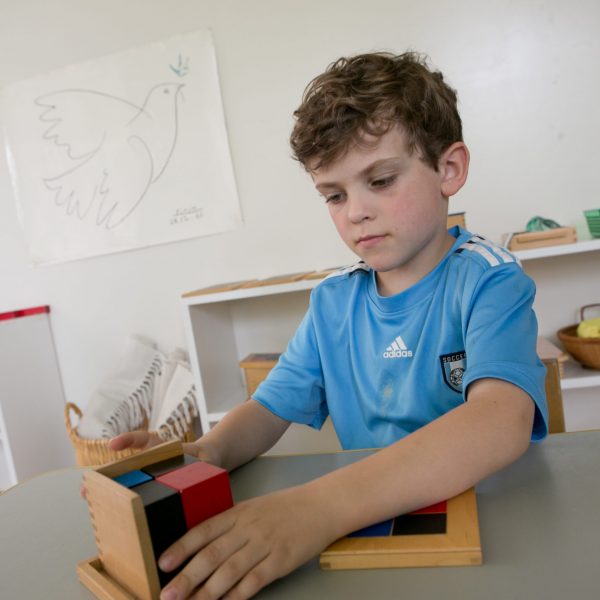
The sensorial material is most deeply explored in the primary class, where the children are passing through sensitive periods related to perception of form, texture, color, weight, sound, smell, taste, temperature: the ways in which we take in information about the world. The materials are not intended to give new impressions, but to order, classify, relate, explore and realize the sense impressions the child has already formed. Each piece of material isolates a single quality: for example, the pink tower shows only variations in dimension. The control of error is visual disharmony -- the child can see that the cubes are not placed in order.
The sensorial materials serve as keys to other areas of learning. Size discrimination is refined through the use of materials to demonstrate length, width, volume and weight; these materials, designed on the base-10 system, lead directly to mathematical awareness. The sound exercises lead into music and composition. Texture is utilized in learning the shapes and sounds of the alphabet. Discrimination of forms extends into geometry, botany, geography, and so on. The language of the material is usually given after the child has explored it: triangle, trapezoid,and square, corolla, calyx, and stem, North America, Asia, and Africa, ... the words crystallize the concepts for the child.
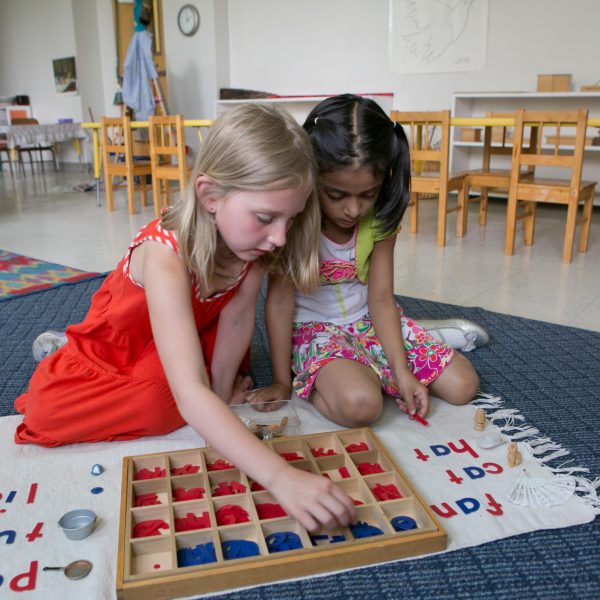
Language is woven into all parts of the program. In the primary class, enrichment of vocabulary continues through the use of classification cards, sensorial materials, and activities. Fine distinctions between words (broom/brush, string/thread) and long words (tyrannosaurus rex) delight the children. Stories, poems, plays and ordinary conversation are important in the environment, but no one is ever pressed to perform. The aim is to increase children's knowledge, organization of thought, and confidence in their ability to use and express their minds. As the child naturally desires to become a reader, he/she is introduced to the phonetic sounds of letters and then to word building with the moveable alphabet in order to blend and read words. This natural progression takes the child into reading words, simple phrases, simple sentences and then books. As they develop skills in building words and reading words, they also begin writing words, and then simple sentences. Foreign language is an important part of our overall language program. Primary children begin with Spanish enrichment lessons once a week.. The program provides a rich, multi-sensory experience. Our students take delight in singing, learning the words for colors, numbers, actions and common objects in the environment. They listen to stories and learn finger plays in Spanish. The goal is to sensitize the child's ear to the sounds of another language at a time when their receptivity to language learning is very strong.
Montessori proposed that all humans are born with a "mathematical mind.” In the Montessori environment, mathematics is an integration of arithmetic, algebra and geometry into a system in which each illuminates the other. The structure of the program follows the interests and abilities of the child's mind.
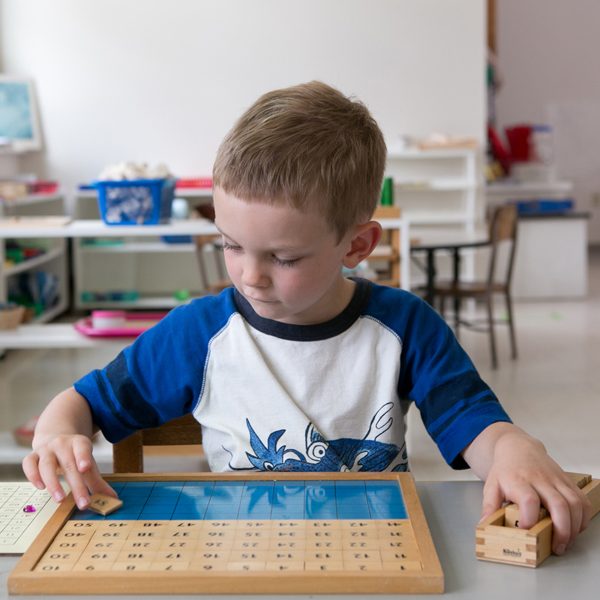
In the primary class the children are given mathematical concepts in the form of objects; the objects can be felt and moved about so that the hand is always involved in the learning process. The children are introduced to counting and mathematical processes with numbers into the thousands using concrete materials that clearly demonstrate the differences between small and large quantities.
History, geography, economics, art and music history, and other general subjects are at first presented to the children through sensorial materials and stories. The birthday celebration circle is an example of how students experience the earth revolving around the sun. The birthday child carries the globe and walks around a candle (that represents the sun) one time for each year of their life. The teacher reads a script about their life as the child walks around the sun. Children explore geography using puzzle maps that go from the whole world broken into continents to continents broken into countries. They learn about landforms using three-dimensional models that allow them to pour water, illustrating the relationships between land and water. For the primary students, the pattern of presentation is to work from the whole to its parts. Children learn about other cultures through pictures, food, music, stories, dance, and customs. Each year teachers prepare a Winter Celebration that focuses on one continent, giving children an evening of crafts, games, refreshments, music and dance from countries on that continent.
As in the other cultural studies, the study of scientific topics, such as botany, zoology, and physical sciences, is integrated, multi-sensory, and follows a path of concrete and basic to abstract and complex. Efforts are made at every level to achieve a strong balance between explorations of real materials and use of print sources, models, and charts to develop scientific understanding of the way the world works.
In botany, for example, the primary children analyze a real plant into basic parts: corolla, calyx, stem, leaf, root. Using pictures, puzzles and models, each part is then broken into more parts: types of leaves, venation of leaves, margins of leaves. An appreciation for botany is further enhanced by the presence of living plants in the classroom. Children take turns watering the plants giving them the opportunity to not only learn about plants, but to experience care of the environment as they share this responsibility.
Creative work is woven into the life of all the classes. The emphasis is not on "self-expression" but on "self-realization.” We enrich the classroom spaces with fine painting, good music, visiting artists and special programs so that the arts become an integral part of the prepared environment. We assume that to create is essentially to realize, from what is known and understood, a new idea or a new form: that is, an outward expression of interior development. The child's own creative energy is used everywhere in the program as he discovers and teaches himself. Painting, studying music, composing, writing stories all begin in the primary class. In an environment that is ordered, beautiful, and rich in possibilities, the child acquires something to paint about, dance about, and compose about.
Music education begins with the sensorial materials in the classroom and grows to include formal lessons and performance opportunities. The music teacher who works with the older children also meets once a week with children in our primary afternoon program. Children learn about rhythm and melody through singing and exploring different rhythm instruments. In addition to this weekly activity, classroom teachers use music regularly in circle times, by playing different kinds of recorded music for the children to hear and using songs and fingerplays to enrich the children's learning.
Primary children are given activities that encourage coordination and control of movement such as walking in line to music and the silence game. They exercise every day outdoors or in the all-purpose room.
At the primary level, the Montessori process does not include assigned homework. The children often create homework for themselves. Montessori materials are inappropriate for home use--their presentation and use is part of an intricate scheme.
There is so much that can be done at home with children, the notion of homework as schoolwork is truly insignificant. Practical life activities are essentially a matter of involving children in the everyday processes of life: cooking, cleaning, caring for pets, gardening, and so on. Reading to your child every day and language sharing--giving names of plants, shells, tools, and whatever interests you--are other important gifts.