The New School of Lancaster

Upper Elementary

Age Range: Ages 9 years to 12 years (Grades 4 - 6)
Time: 8:30 a.m. – 3:00 p.m.
Class Days: Monday – Friday

In Upper Elementary, our collaborative approach models and promotes self-confidence, self-respect and respect for others. Students work independently… plan topics for study… work in small groups… learn research techniques… explore hands-on environmental activities… engage in class meetings and debate… present oral reports… structure their time… assist younger students… apply their research to real life issues… begin to understand how they are connected to the world.

Upper Elementary Curriculum

Our classrooms are collaborative communities that foster order, respect, and a child’s innate desire to learn.  Multi-age classrooms allow students to work together and learn from each other. Our teaching method respects individual differences and learning styles.  Specially designed materials lead from concrete experience to abstract knowledge.  Our integrated approach to learning encourages universal thinking.  The curriculum becomes increasingly integrated so that what most adults call “subjects” are rather facets of a larger design.


Elementary Phase-In Information 2012

Practical Life Language Mathematics Cultural Studies Science The Arts Physical Education Homework
In the elementary classes, practical life relates to the community outside the school. "Going Out" involves more than ordinary field trips, as the children plan, prepare, make arrangements, write letters, whatever is necessary to explore a museum, a factory, a farm, a library. The sensitive period for order seems to have vanished by 6 (you will notice this at home, too), but projects like planning celebrations, food preparation, knitting and simple sewing appeal to elementary students. Care and cleaning of the classroom is also a daily exercise of practical life for older students.
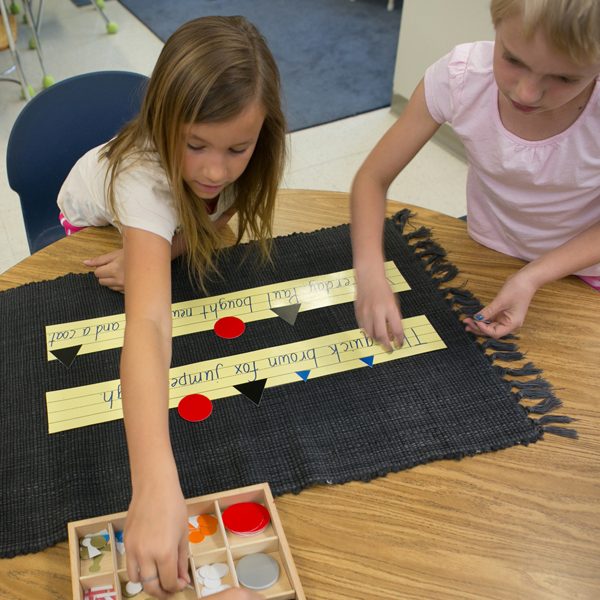
In the elementary class, language work continues, including word study, history of language, analysis of sentences, construction and style, spelling and vocabulary. The children write and illustrate stories, poems and research reports, sometimes quite long; and often research is presented orally to groups of classmates. Total reading includes a critical approach, the ability to question what has been read and compare different points of view. Materials are presented in all areas of the curriculum to aid in the development of reading at all levels.

Foreign Language is an important part of our overall language program. The curriculum is presented as a rich, multi sensory experience. Our students take delight in singing, speaking, listening, reciting, conversing, and learning about Spanish cultures worldwide. From the beginning of upper elementary (traditional 4th grade) writing in Spanish becomes an integral part of the students' learning. As in English, students learn to write for many purposes: to answer questions, to tell stories, to write letters and to translate from one language to the other.
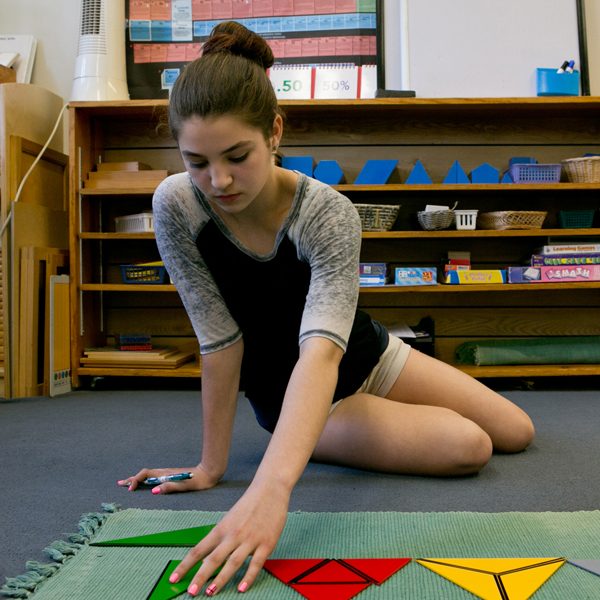
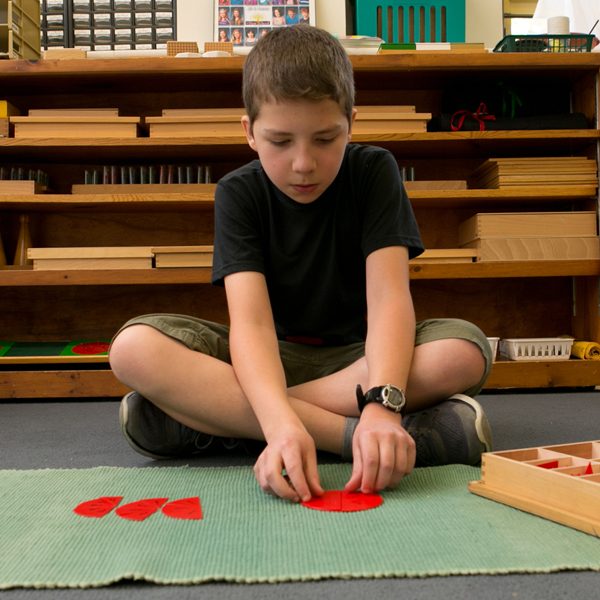
In the elementary class, work begun in the primary years continues. Learning is built on materials and concepts already presented and new concepts such as algebraic computation, base systems, square and cube roots are added. The materials are intended to lead the child into more and more abstract work, until finally the materials are spontaneously discarded. Concepts are introduced earlier than in traditional classrooms, while memorization of arithmetical facts may be mastered on about the same timetable. Children are led not only to memorize facts and complete operations, but also to understand those operations as concrete manipulations of quantities.
History, geography, economics, art and music history, and other general subjects are at first presented to the children through sensorial materials and stories. Children explore geography using puzzle maps that go from the whole world broken into continents to continents broken into countries. They learn about landforms using three-dimensional models that allow them to pour water, illustrating the relationships between land and water. As children progress through the elementary years, they learn about cultures, political, economic, and physical relationships, and the history of mankind. Information is organized and presented in an integrated fashion. Literature, art and music studies, maps and histories all focus on one area of the world at a time. Children learn about other cultures and their own through the lens of the fundamental needs of humans. They discover that people through time and across space have found varied ways to meet their common needs for food, shelter, government, and others that encompass the rich panoply of human activities that create our cultures.
As in the other cultural studies, the study of scientific topics, such as botany, zoology, and physical sciences, is integrated, multi-sensory, and follows a path of concrete and basic to abstract and complex. Efforts are made at every level to achieve a strong balance between explorations of real materials and use of print sources, models, and charts to develop scientific understanding of the way the world works. In the elementary classes the knowledge of parts of plants and animals is used to understand functions of the various parts and systems of classification. Additionally, there has been a study of the needs of living organisms and ways that each one contributes to the larger whole of life on earth, so that botany and zoology are integrated with geology, chemistry, nutrition, geography, and so on.
Creative work is woven into the life of all the classes. The emphasis is not on "self-expression" but on "self-realization.” We enrich the classroom spaces with fine painting, good music, visiting artists and special programs so that the arts become an integral part of the prepared environment. We assume that to create is essentially to realize, from what is known and understood, a new idea or a new form: that is, an outward expression of interior development. The child's own creative energy is used everywhere in the program as he discovers and teaches himself. Painting, studying music, composing, writing stories all begin in the primary class. In an environment that is ordered, beautiful, and rich in possibilities, the child acquires something to paint about, dance about, and compose about.

Elementary and middle school students undertake larger projects as part of their Fine Arts curriculum. This includes working with our Art Teacher, who provides sophisticated exposure to art history, and a variety of media (paint, clay, paper, textiles and color). Children's art is displayed at our annual art show, which has been hung in various locations throughout our local community.

Music education begins with the sensorial materials in the classroom and grows to include formal lessons and performance opportunities. Children from early elementary to middle school participate in weekly lessons with a Music Teacher. Children move from learning about rhythm and melody in the early years to reading and composing music as well as singing and basic instrumental performance. Students have many opportunities to perform for their classmates as well as the larger community.
Organized sports activities for elementary students include outdoor and indoor physical education games, teamwork and individual skill development. As the children grow older, we integrate their need for physical education with our practical life goal of community integration. Traditional, competitive games are taught as well as cooperative games. Students learn how everyday activities such as weeding, digging, climbing, and walking can add to their overall fitness. The goal is to lead children to an understanding that will enable them to make choices that support health and fitness for the rest of their lives.
Elementary students will begin to experience homework. Our goals are to make the connection between home and school stronger, to give parents a chance to see their children's work at home, and to begin to develop in the children a greater responsibility and good work habits. As the children enter upper elementary, their work is not divided into school work and homework, but rather work that has completion dates. Work done at school does not need to go home; conversely, work not completed at school will need to go home. This gives them a "real-life" reason to learn to manage their time and choose their actions.